




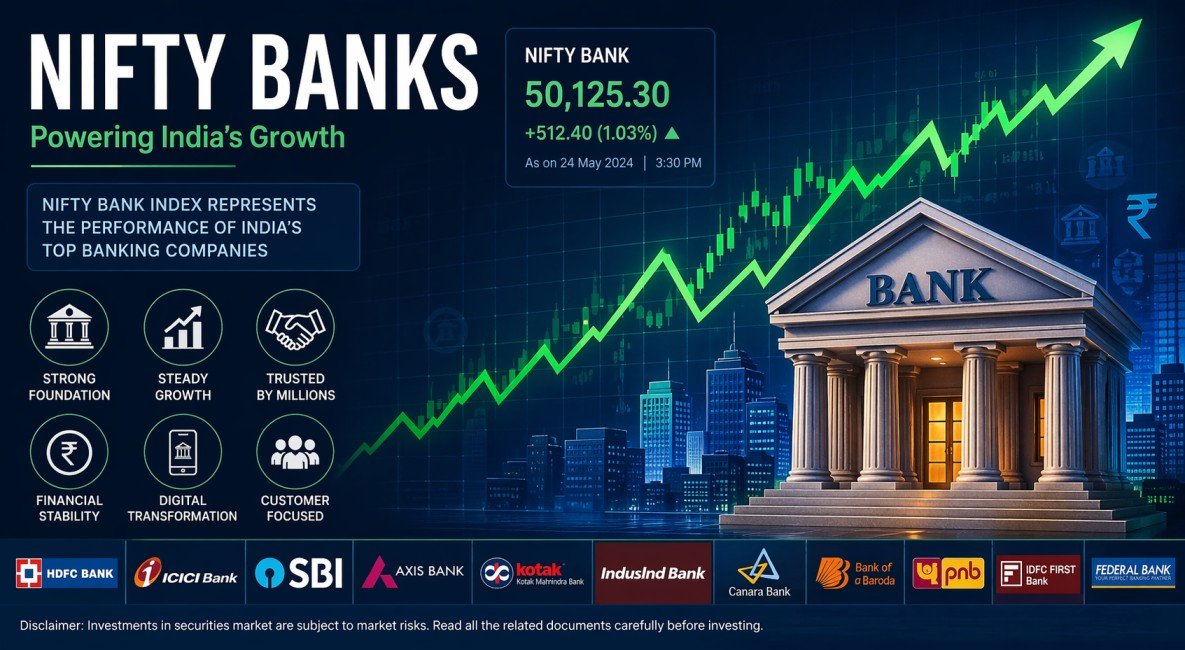
Nifty Bank Surge or Crash? Key Factors Driving the Banking Index in 2026

Will Nifty Bank Escape or Falter?. Main elements influencing the banking index in 2026.
Opening Remarks
The functioning of Indian stock markets has always been correlated with its banking sector continuously. Nifty Bank is among most essential indices, representing the financial sector, which is backbone of Indian economy. The banking stock index is one of the most watched indices when an index is going up or down.
As we move toward 2026, things are getting tougher and more exciting at the same time. The banking sector is set to transform thanks to global economic shifts, changing interest rate cycles, ongoing digital transformation, and evolving demand for credit. Investors want to know One big Question: Will Nifty Bank rise or correct in 2026?**.
No, they didn’t steal. Many interlinked variables influence the index, such as domestic growth as well as global financial conditions. The index can scale higher with a stronger credit growth cycle while higher NPAs or global instability can push it down.
Explore the Detailed Article which explains the Nifty Bank in 2026 in detail. It includes every important factor driving the index along with possible scenarios of growth and decline, key risks, and strategic tips. If you are an investor, trader or financial learner, this piece is for you as it helps one understand the real forces shaping India’s banking sector.
Nifty Bank is the backbone of financial markets.
The Nifty Bank Index comprises 12 of the most liquid and large-cap banking stocks listed on the National Stock Exchange of India. The main banks of both the public and private sectors that distribute credit in the country.
The index is a benchmark of the entire banking sector and is used for tracking financial stability, investor sentiment and economic momentum.
Essential Role of Nifty Bank
Why Nifty Bank Is Important.
- Represents The Banking System Health
- It affects the market mood in general.
- The product is very liquid and actively traded.
- It responds rapidly to fluctuations in the economy.
- Important banks are included in it.
Indian economy is benefitted by the banking stocks through getting the loan, managing deposits, supporting the businesses, and others. As a result, a change in banking performance affects the entire market.
Nifty Bank in 2026: Overview of Market Environment.
The global and Indian markets expect a 2026 with extreme volatility. The outlook on banking stocks is shaped by macroeconomic trends.
Economic Background.
- After years of market shocks, the global interest rate cycle might steady.
- India’s GDP growth likely to remain robust compared to Global Peers, says report.
- More and more people are adopting digital banking.
- Demand for credit from retail & corporate sector continues to expand.
- Inflation trends not so extreme but still uncertain.
These conditions create both possibilities and dangers for the Banking sector. The market direction can quickly change course due to unexpected shocks and different policies.
Primary Drivers of Nifty Bank in 2026
Nifty Bank does not move without a reason. The combination of macro, sector and global variables influence the scenario.
**1. Interest Rates as determined by RBI policy.
The environment in which the central bank sets interest rates serves as one of the key drivers of banking stocks.
When rates are on the up.
- Lending comes with high twin margins for banks.
- Profitability enhances shortly after the activity.
- The demand for loans could decelerate.
Rates Start Falling.
- Demand for loans rises.
- A contraction in net interest margins.
- Business and individuals find it cheaper to borrow
The Reserve Bank of India (RBI) has to balance inflation and growth; analysis shows that growth rise comes at the cost of inflation; and vice versa. Changes in the monetary policy instantly reflect on Nifty Bank.
**2. increase in credit in economy
Growth in credit is key for banking profit.
In the year of 2026, strong credit demand is.
- Loans for housing.
- Individual loans.
- Lending to MSMEs.
- Company expansion lending.
Should credit growth continue to flourish.
- Bank revenues rise.
- The loan books grow larger.
- Prosperability enhance.
Economic uncertainty could hamper demand and pressure banks’ earnings, led by low-growth sectors.
**3. Unproductive Assets.
Loans that borrowers do not repay are NPAs. Banks face one of the largest risks from them.
An increase in non-performing assets suggests.
- Borrowers suffering from financial disadvantage
- Tension in the economy.
- Banks gain less profit.
Trend of fall in NPAs
- Increased credit discipline.
- Generally speaking, recovery efforts rather successful.
- Efficiency of banking system improve
In 2026, the Nifty Bank’s asset quality will be the main focus of investors.
**4. Trends in Payments and Inflation
Inflation has an impact on borrowers and also lenders.
The result of high inflation.
- Interest boost.
- Lowered customer spending.
- Stress on the capacity to repay loans.
Inflation support mechanism.
- Sustained interest rates
- Steady advancement of credit.
- Enhanced profit margins.
The performance of the banking sector will depend on inflation being managed in India.
**5. Flows of Foreign institutional investors
Foreign funds flow into Indian banking stocks significantly.
When there is FII Inflows Increasing.
- you can say something like: India benefits from strong GDP growth.
- The currency is stable.
- Corporate profits grow.
When there are FII outflows.
- Worldwide danger escalation.
- U.S. Interest rates increase
- Sentiment of emerging markets weakens.
When money pours into Nifty Bank, it can trigger a sharp rally and vice versa.
**6. Economic Conditions Globally.
The banking sector is not insulated from global trends.
World factors of global include.
- Policies of the US Federal Reserve.
- A Constant Change In Oil Price
- Tension caused by geopolitics.
- Anxieties of worldwide recession.
As India is part of global financial systems, external shocks frequently percolate to impact domestic banking sentiments.
**7. The Changing Landscape of Banking
The entire banking ecosystem is reshaped by technology.
Popular trends contain.
- Online loan seeking sites
- Payment technologies between UPI and instant.
- Credit scoring using AI.
- Enlargement of on-line banking
Advantages.
- Reduce operational costs.
- Quicker loan processing.
- Enhanced Customer Experience
Obstacles.
- Cybersecurity Threats
- Rivalry offered by fintech organisations.
Banks that evolve quickly through digital transformation will outperform 2026 competitors.
**8. Government Policies as well as Banking Reforms
Banking performance is greatly influenced by government policies.
Key areas include.
- Inclusivity should include finance schemes.
- Programs for infrastructural funding.
- The consolidation and reforms of banks.
- Changes to regulations.
Supportive policies can enhance credit growth and market sentiment for Nifty Bank.
**9. Business Profits and Profits
The stock prices of banks are driven by their earnings.
Indicators that show profitability.
- Net Interest Margin.
- The profitability of the firm.
- Return on common equity (ROE).
- Price-to-earnings ratio.
Nifty Bank tends to perform well when there is strong earnings growth.
**10. Market liquidity and investor sentiment.
Market sentiment often drives short-term movements.
Feelings cause results.
- Increased market demand.
- There seems to be an uptrend in banking stocks.
Negative emotion creates.
- Urgent sell-off.
- Fluctuations intensify.
Liquidity in financial markets facilitates the flow of prices but can cause price swings.
Positive Forecast: Nifty Bank Could Hit 72000 by 2026.
The Nifty Bank could see a strong uptrend due to several factors.
- Robust economic development India’s GDP growth.
- Credit demand up across sectors.
- Constant inflation and interest rates.
- Enhancement of bank profits.
- Lowered NPAs and enhanced balance sheets.
- Uninterrupted inflow of FIIs.
- Keen global market sentiment.
In this regard, banking stocks can outperform broader indices owing to their direct linkage with growth.
Bearish Scenario: Nifty Bank Could Come Under Pressure
On the other hand, some risks can produce regressions.
- A world slowdown or recession.
- The economic stress is leading to mounting NPAs.
- Interest rates saw a big hike.
- Outflows of FII from emerging markets.
- Disappointing results from corporations.
- Unstable geopolitics.
Should there be convergence of negative factors, a correction in the Nifty Bank may occur.
Banking Sub Sectors of Nifty Bank
Different banks react differently to different types of changes.
Public Sector Banks (PSBs)
- Government is strong.
- Enhancing the quality of Assets.
- Sensitive to changes in policies.
Corporate Banks.
- Improved effectiveness.
- Widespread use of digital technology.
- More profitable measures.
Contemporary banking
- Operations that use technology.
- Quick Filing of Customer
- More competition involvement.
Awareness of these segments helps in better index movement analysis.
Investment Perspective Trading Perspective
Perspective on Investing Long-Term
Invest in the long haul.
- Profits Growth.
- Condition of an asset.
- Fluctuations of the economy.
They earn compound returns during phases of expansion.
This is Short-Term Trading View.
Investors pay attention to.
- Fluctuation in market prices.
- Movements driven by news.
- Patterns related to tech.
Nifty Bank is one of the most volatile indices, which is great for active traders.
Risk management in banking index exposure
Investors must tactfully manage risk trading the volatile Nifty Bank index.
Essential Guidelines Involve
- Diversification Across Sectors.
- Staying Away From Excessive Leverage
- Monitoring macroeconomic factors.
- Practicing stop-loss discipline.
- Gaining insight into market fluctuations.
Risk management is an important part of investing or trading decisions to ensure long-term sustainability.
Future Outlook of Nifty Bank Beyond 2026
The extent forecast hold well with India’s growth story.
Projected Patterns
- The growth of credit penetration.
- A powerful ecosystem for digital banking.
- More participation by retail.
- Merger in banking sector.
- Enhanced worldwide interconnectedness.
If the trends continue, Nifty Bank will continue to be a growth-shaper in the Indian equity market.
Most Asked Questions
1. What is Nifty Bank?
Nifty Bank is a benchmark index of banking stocks from the National Stock Exchange of India.
2. What is the significance of Nifty Bank?
The health of the banking sector is critical for economic growth.
3. What affects Nifty Bank the most?
Rates of interest, credit expansion, non-working assets, inflation and global economic situation.
4. Is the Nifty Bank going to crash in 2026?
During severe events such as global recession, rising NPAs or major financial shocks, yes.
5. Is Nifty Bank a good long-term investment?
In the past, banking sectors have performed well during economic cycles, making them great picks for the long term.
6. What is pushing the Nifty Bank up?
A strong performance, credit growth, low NPAs, and positive market sentiment.
7. How Nifty Bank works with RBI policy?
The interest rate decisions made by the RBI impact lending margins and loan demand.
8. Is Nifty Bank a Risky Bet?
Indeed a high volatility index due to many macroeconomic reasons.
9. Which banks are counted in Nifty Bank?
It contains large public and private sector banks listed in India.
10. Can digital baking affect Nifty Bank performance?
This is an affirmative statement. Digital Transformation would help in gaining efficiency and profitability in the long run.
Final thoughts.
The Nifty Bank is one of the strongest indicators of Indian India economy. In 2026, it is expected to move under the influence of domestic growth, global conditions, the policy of the monetary system, and the process of technological transformation.
While there is potential for a spike due to firm credit offtake and economic activity, threats from geopolitical instability, inflationary pressure and asset quality stress can’t be ruled out. Traders are likely to see volatility leading to opportunity.
For investors and analysts, it is necessary to understand the driving factors behind the activities to understand the activities of the market. Whether Nifty Bank gains strength and momentum or faces corrections will depend on the evolution of the various macro and micro factors.
Rejection of Responsibility
This article only intends to educate and inform. This should not be taken as financial advice. Investing in the stock market is subject to market risk; past performance may or may not be sustained. Before making any investment, you must consult a certified financial advisor.
About the Author
This article has been jointly written by a financial content analyst, a stock market researcher, and a macroeconomic and sectoral analyst. Working with interactive visualization, the author simplifies complex financial concepts to help users the behavior of the market piecemeal.
