


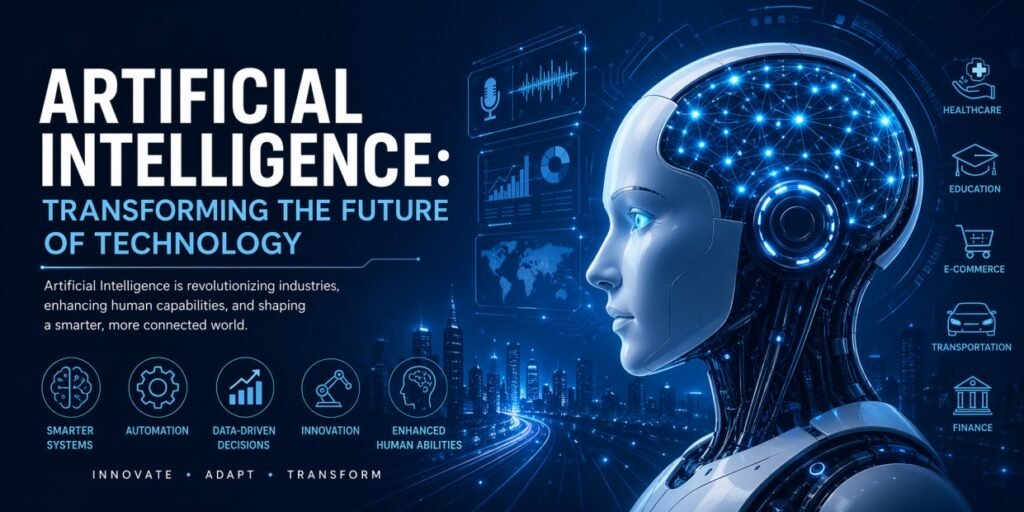
Artificial Intelligence: Control the Future of Technology
Artificial Intelligence (AI) is no more a concept of science fiction or future hinting and is very much real. One of the driving forces of the world has been technology. Artificial Intelligence is having an impact on human life in numerous ways. From mobile phones, social media algorithms, healthcare systems to self-driving cars.
This write-up specifically evaluates the impact of artificial intelligence on the future of technology and its workings, advantages, future impact and challenges in the coming years.
Introduction to Artificial Intelligence
Artificial Intelligence is the simulation of certain human intelligence processes by machines. These processes include learning, reasoning and self-correction. A computer or robot with the ability to perform tasks commonly associated with intelligent beings has been described as artificial intelligence (AI).
Artificial Intelligence is not one technology but uses several advanced technologies such as machine learning, deep learning, natural language processing, robotics, data analytics, and more. Machines enhance their performance over time without programming for each skill thanks to both technologies working in coordination.
Development of Artificial Intelligence
The development of artificial intelligence has been ongoing for decades, and recent advancements in computing and data have further accelerated its expansion.
Initially, AI systems were what you call rule-based meaning they implemented user instructions. Nonetheless, present-day AI systems acquire knowledge from the data and experiences they have. This has helped AI become increasingly generalised, flexible, expert and powerful.
The key stages of development of AI:
- The systems which used rules earlier
- Introduction of machine learning
- The Emergence of Deep Learning Models
- The process of creating AI systems
- Incorporation of AI in day-to-day activities
Today, AI is utilized in almost every major industry, making it one of the transforming technologies of the 21st century.
How does artificial intelligence work?
AI systems utilize huge data sets to establish patterns that help make predictions on new data. These systems employ algorithms through which machines can learn through experience.
The essential elements of Artificial Intelligence are:
- Collecting data from various sources in large amounts
- Cleaning and organizing data for data analysis
- Training algorithms to identify patterns is machine learning models
- Making outputs based on learned information
- Ongoing knowledge enhancement that raises precision
As more data are entered into them, the intelligence of AI systems continues to increase, thereby making them efficient in carrying out complex tasks.
The Most Important Types of Artificial Intelligence
The term “artificial intelligence” encompasses a wide range of computing systems.
Specialised artificial intelligence
Specialized Artificial Intelligence systems or Narrow AI are used in audio, video, and other similar applications. It is the most used type of AI today.
Overall AI
The general AI is a code that help to create machines that can performs is intellectual task. Research is still ongoing to develop it.
Third, Super AI
Super AI refers to a hypothetical future AI that will be smarter than a human being in practically every field.
Uses of AI in modern technology
AI is changing almost every industry nowadays. The applications of this software are vast and rapidly expanding.
Wellness care
By facilitating early diagnosis for disease detections, AI is changing the medical field for the better. It helps physicians make quicker and better decisions too.
Learning and Teaching
Students are given personalized education experiences through AI. Adaptive intelligent tutoring systems respond to various learning styles.
Money management
The use of AI in banks and other financial institutions is for fraud detection, risk assessment, and more.
Conveyance
Artificial intelligence is driving development for smart vehicles, traffic prediction systems and route optimizers.
Entertainment
Movie, music and shows recommendation through AI is increasingly used in today’s streaming platform.
Online transactions
AI personalizes online shopping with recommendations, chatbots, inventory management, and more.
Producing Goods
AI-powered robots enhance operational efficiency, minimize mistakes, and ensure safety.
Advantages of Artificial Intelligence
There are many advantages of an artificial intelligence which are given in detail:
- Enhanced effectiveness and output
- Lessened mistakes from man
- Quicker decision-making operations
- Similar ideas with a business theme
- Enhanced customer interactions
- Data analysis capabilities that are advanced
- Lowering costs associated with their operations
Organizations are doing more with Less with AI. This is driving innovation.
Difficulties and dangers of artificial intelligence
So basically, there are some issues with AI that must be tackled.
Job Loss
Some jobs may disappear because of automation that is involved in repetitive tasks.
Consideration of Privacy
AI methods work on large datasets which causes privacy and data security issues.
Algorithmic bias
Racial or gender bias in AI system decisions can lead to unfair outcomes.
High Initial Costs
New and maintaining different AI systems can be costly for organization.
Moral dilemmas
Raising worries of delegation and control over emerging technologies.
The Contribution of Artificial Intelligence towards Reality of Future Technology
The future of technology is expected to be dominated by Artificial Intelligence. It will keep on merging with upcoming tech such as blockchain, quantum computers, and the Internet of Things (IoT).
We may develop more in future:
- Transportation systems with full autonomy
- Cities powered by AI
- Advanced robots are used in daily life
- Health Diagnoses using AI
- Chatbots like humans
- Forecasting tools for worldwide obstacles
The tech world of tomorrow will be inextricably linked with AI.
Artificial Intelligence a Part of Daily Life
In daily life, AI is already part of daily life for a lot of people.
These include:
- Digital assistants like Siri and Google Assistant
- Algorithms of Social Media Feeds
- Filters for email spam
- Suggestions for shopping online
- Intelligent household gadgets
- Apps predicting traffic flow forecast
These applications illustrate how AI has embedded itself into the everyday fabric of life.
The ethics of artificial intelligence
As artificial intelligence grows, ethical considerations are becoming increasingly important.
There are several important concerns of ethics:
- Making AI systems transparent is crucial
- Dealing with Data collection
- Avoiding the abuse of AI technologies
- Promote fairness and minimize bias
- Ensuring responsibility for AI software choices
Governments and organizations are putting laws in place so AI can be developed responsibly.
Upcoming Trends People of AI
Within few years, Artificial Intelligence is expected to evolve rapidly. Trends that are emerging:
- For creation generative ai content
- AI-based cybersecurity systems
- Collaboration of Human and AI in Workplace
- Emotional AI able to grasp human emotions
- use of ai in space exploration
- Completely automated business operations
AI is all set to penetrate every field & this is quite evident from the trends.
The significance of Artificial Intelligence in the digital world
In our digital era, having AI is not an advantage but a necessity. Businesses have a greater risk of being left behind with implementing AI technologies.
AI assists in organizations:
- Get to Know Your Customers
- Ensure better decision-making
- Make operations optimal
- Enhance your profits
- Outpace competition with innovation speed
Digital transformation will continue, AI will be at technology’s get-go.
Commonly Asked Questions
Artificial intelligence is another word for machine learning.
Artificial intelligence is the ability of a machine to perform tasks that ordinarily require human intelligence.
Can Artificial Intelligence be trusted?
When it is developed responsibly, AI is safe. However, it needs to be regulated to prevent misuse.
The AI will replace human jobs?
Some jobs will be taken over by AI but there are also other jobs that will be generated due to it.
Examples of AI in our daily life are smart assistants and chatbots.
Voice assistants, recommendation systems, navigation apps, and social media algorithms are a few.
Is it possible that AI can think like humans?
AI can perform certain tasks like humans using human-like thinking but does not feel anything like humans.
In summary
Artificial intelligence is a powerful technology that is shaping the future of mankind. It changes the work done and efficiency, and also making things which were not possible. Though AI has many advantages, it also brings its own challenges which should be dealt with responsibly.
With the advancing technology, the role of AI will become more important in living together with human beings. To adapt and be successful in the future, this transformation must be understood by people, businesses and societies.
Disclaimer
This article is for informational and educational purposes only. The information here is from what is already known about artificial intelligence and is not professional legal and technical advice. Readers are encouraged to do their own research or consult an expert before taking any action based on this.
Author’s Biography
The author is a creator of digital content and writer on technology. She specializes in new technologies, AI, finance and online trends. The author intends to generate material that clears up confounding issues, with the author’s goal being to create clear, informative, and SEO-friendly content about modern technologies and their impacts.
Author Name: Aditi Thakur


